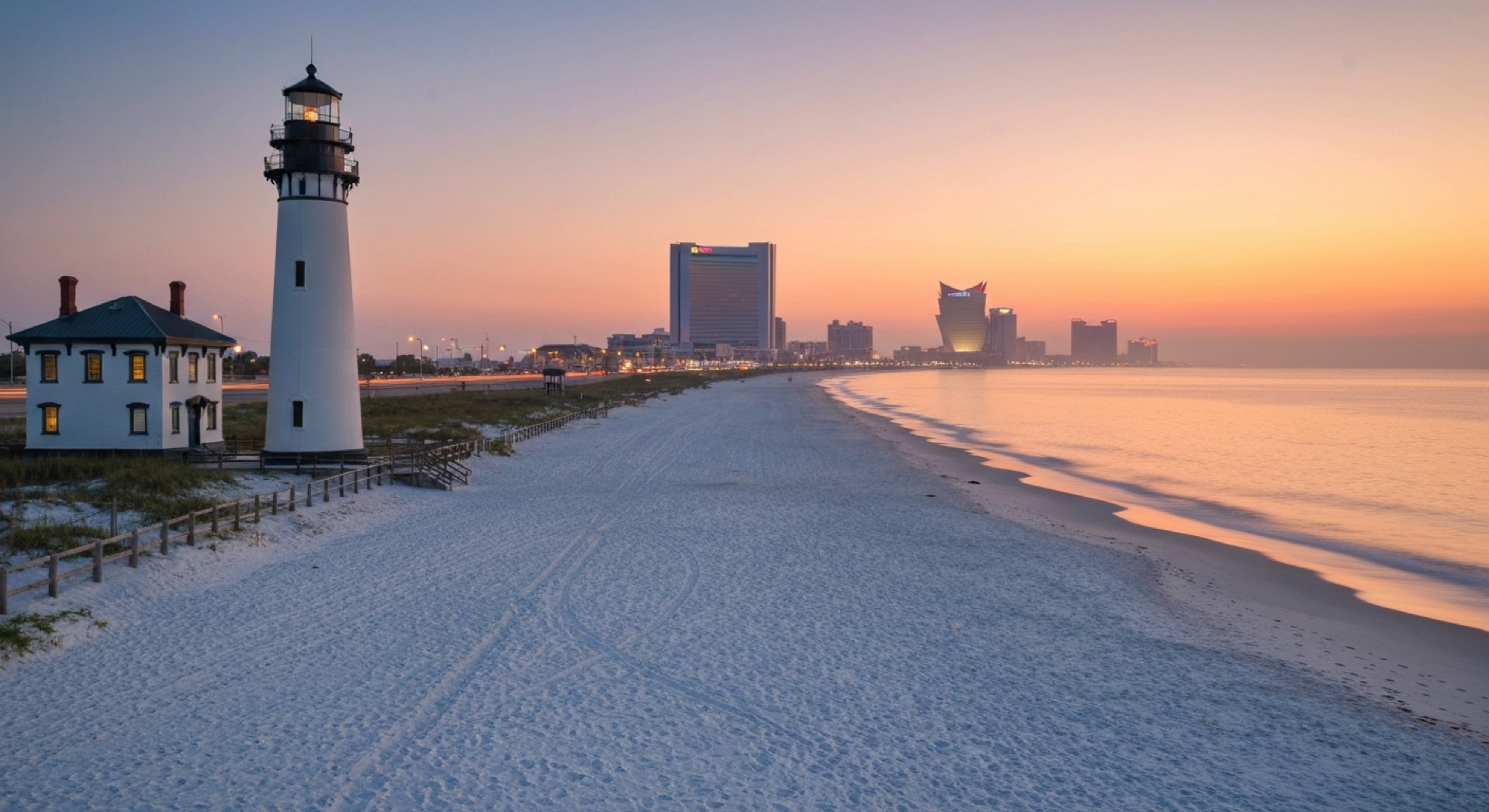
Biloxi's economy is built on a foundation most Mississippi cities do not have: a casino and resort industry that draws millions of visitors from across the Southeast and generates billions in annual revenue for the region. MGM, Hard Rock, Beau Rivage, and a half-dozen other resort properties dominate the beachfront corridor, but the real small business opportunity lives in the ecosystem around them. Seafood restaurants, tour operators, auto repair shops, healthcare providers, specialty retail, and contractors serving both tourists and a permanent population of roughly 46,000 make up the backbone of local commerce here.
The seafood industry remains a cultural and economic anchor for Biloxi, tied to the city's history as one of the Gulf's original canning and shrimping hubs, though the active fleet is smaller than it was in prior generations. Keesler Air Force Base adds another distinct economic layer: a large active-duty and veteran population with stable household income and a consistent demand for local services ranging from housing to healthcare to auto repair. That base population is less seasonal than the tourist trade and often represents steadier clients for service businesses.
Digital marketing in Biloxi presents a challenge that is specific to this city: local businesses operate in the visual and brand shadow of major hospitality companies with enormous marketing budgets and nationally recognized names. A new customer arriving in Biloxi has already seen polished websites and professional photography from the major resorts. That exposure raises the implicit quality bar for every local business website they encounter afterward, even if they never consciously compare them.
The good news is that a plumber, dentist, or HVAC company in Biloxi does not compete with Beau Rivage for search visibility. Google's local algorithm surfaces results by category and proximity, not by brand size. A well-optimized local service business can rank at the top of its category without ever going head-to-head with a major resort property.
The competition is the other HVAC companies, the other dental practices, the other auto shops, and most of those competitors are not running disciplined SEO or maintaining their Google Business Profiles with any consistency. That gap is the real opportunity in this market.
Biloxi has a split market, and the split matters for how we build strategy here. On one side are the tourism-dependent businesses: restaurants, entertainment venues, tour operators, and retail near the casino corridor where visibility to out-of-town visitors matters as much as local resident search. On the other side are the service businesses, healthcare providers, contractors, and auto shops that primarily serve the permanent population and the Keesler base community.
These two segments require different tactics even when the underlying tools are the same. For tourism-adjacent businesses, we focus heavily on Google Maps prominence, photo volume, and review velocity. Visitors search on mobile in real time while they are already in the city, which means the Map Pack is often the first and only result they look at.
Being in the top three for 'seafood restaurant Biloxi' or 'things to do near me' during a tourist's phone session can directly drive same-day foot traffic. Review recency matters more in this segment than in most markets because visitors from other states cannot rely on word-of-mouth networks the way locals can. A business with 200 reviews but the most recent one from eight months ago looks less active to a visitor than one with 80 reviews and three posted last week.
We build review request systems that keep that recency clock running consistently. For Biloxi service businesses serving residents, the strategy looks more like traditional local SEO: GBP completeness and category precision, citation consistency across local and national directories, on-page content that targets the specific neighborhoods and zip codes where customers live, and a review volume that signals credibility without requiring a viral moment. The 39530, 39531, 39532, and 39533 zip codes each represent distinct service zones, and targeting content at the right geographic concentration improves relevance signals for searches in those areas.
The Biloxi-Gulfport metro adds another layer: businesses that serve both cities can capture search demand from both markets if their geographic targeting is set up correctly. Proximity and service area settings in GBP directly affect where the business appears in map searches, and most local operators have never touched those settings deliberately. We audit and correct them as a baseline step for every client in this market.